
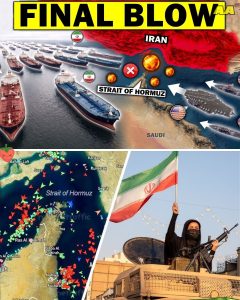
Iran’s oil empire is facing a devastating collapse as a tightening naval blockade turns Tehran’s greatest economic weapon into a trap of its own making.
For decades, Iran treated energy as its ultimate shield.
Oil funded the regime.
Oil financed its regional allies.
Oil gave Tehran leverage over the Gulf, global markets, and every government afraid of disruption in the Strait of Hormuz.
But that leverage is now being tested in a way sanctions alone never managed to achieve.
According to the source material, the United States naval blockade around Hormuz has begun cutting directly into Iran’s economic bloodstream.
The result is a crisis that is moving faster than Tehran appears able to control.
Iran can still produce oil.
That is not the problem.
The problem is that it can no longer move enough of it.
Tankers are trapped.
Ports are crowded.
Storage facilities are filling.
And once those storage tanks are full, Iran will be forced to reduce production.
That is where the danger becomes far greater than lost revenue.
Oil wells cannot always be turned off and restarted without damage.
If production is cut too sharply, some wells may never recover their previous capacity.
That means Iran may not only lose money today.
It may lose part of its energy future.
The source material claims Iran’s exports have fallen dramatically since the blockade began.
It also describes storage pressure becoming so severe that older, decaying ships are being used as floating storage.
For a country sitting on vast oil reserves, the image is humiliating.
Iran has oil beneath the ground.
It has oil in storage.
But it does not have a reliable way to sell enough of it.
That is the paradox now haunting Tehran.
A petroleum power is being suffocated not because it lacks oil, but because the exits are closing.
The Strait of Hormuz was supposed to be Iran’s great pressure point.
For years, Tehran believed that threatening Hormuz could frighten the world and force concessions.
But the current blockade has reversed that logic.
Instead of giving Iran leverage, Hormuz has become a trap.
Every tanker linked to Iranian routes now faces tracking, inspection, seizure, or delay.
The old tricks of sanctions evasion are no longer enough.
Changing flags does not defeat satellite monitoring.
Turning off tracking systems does not hide a ship from modern naval surveillance.
Shadow routes become useless when physical force blocks the water.
This is what makes the current crisis so different from previous pressure campaigns.
Sanctions could be evaded.
Front companies could be created.
Oil could be transferred ship to ship.
Paperwork could be altered.
But a naval blockade changes the battlefield completely.
It does not merely punish trade after the fact.
It stops trade before it can happen.
That physical reality is now pushing Iran into a dangerous countdown.
The pressure is also spreading beyond Hormuz.
Chabahar, long described as Iran’s alternative route, is reportedly under strain as well.
That port was supposed to be Tehran’s strategic backup.
It offered access outside the Strait and gave Iran a way to claim it had options.
Now, according to the source narrative, that backup is also being choked by maritime enforcement.
Tankers wait.
Cargo stalls.
And Iran’s plan B begins to resemble another dead end.
Meanwhile, the United Arab Emirates is moving in the opposite direction.
The UAE has a major advantage Iran cannot easily match.
Its Habshan-Fujairah pipeline allows oil to move directly to the Gulf of Oman without passing through Hormuz.
That matters enormously.
If the UAE can increase output and exports through Fujairah, Iran’s old threat to paralyze the Strait loses part of its power.
The source material presents the UAE’s reported OPEC shift as a major blow to Tehran’s energy strategy.
By stepping away from quota limits, Abu Dhabi could gain more flexibility to supply markets independently.
Even if infrastructure limits remain, the political message is unmistakable.
The Gulf is adapting.
Iran is being bypassed.
And the region’s energy map is changing without Tehran’s permission.
This creates a two-front disaster for Iran.
It is losing export volume because its own oil cannot move freely.
It may also lose price leverage if other producers increase supply.
Less oil sold at weaker prices is exactly the kind of pressure that drains a regime from the inside.
That pressure is already threatening Iran’s domestic stability.
The source material describes warnings from security officials that protests could return as economic conditions worsen.
That is the nightmare scenario for any government built on control.
Foreign pressure can be blamed on enemies.
But unemployment, inflation, shortages, and power cuts are felt at home.
They enter kitchens, workplaces, markets, and streets.
They become personal.
They become political.
And they become dangerous.
The reported risk to private-sector jobs is especially explosive.
If millions lose work while prices rise and imports shrink, anger will not remain abstract.
It will become visible.
It will become loud.
It may become impossible to contain without force.
That is why the energy crisis is not just an economic story.
It is a regime survival story.
Iran’s regional network is also exposed.
For years, oil money helped finance Hezbollah, the Houthis, Iraqi militias, and other aligned groups.
That system required cash.
Missiles require cash.
Drones require cash.
Salaries require cash.
Logistics require cash.
If the money slows, the network weakens.
The regime’s foreign power was built on a financial artery that now appears dangerously clogged.
This may be the most damaging part of the blockade.
It does not simply hit Iran’s treasury.
It hits the entire structure Tehran spent decades building across the region.
A military strike can destroy a facility.
A blockade can starve a system.
That is why Tehran now faces such a painful set of choices.
It can negotiate and put its nuclear program fully on the table.
But that could look like surrender to hardliners inside the regime.
It can resist and allow the blockade to continue.
But that risks economic collapse and renewed unrest.
It can escalate militarily.
But that could invite a far more devastating confrontation.
None of the options are clean.
None are painless.
And every delay makes the costs heavier.
For decades, Iran sold the myth of resistance.
It claimed sanctions could not break it.
It claimed pressure would only make it stronger.
It claimed the regime had mastered survival.
But this crisis is exposing a harsher truth.
Resistance needs money.
Defiance needs exports.
Power needs logistics.
And slogans cannot move oil through a blockade.
The regime once believed it could threaten the region into submission.
Now it is watching regional actors adapt, buyers hesitate, insurers withdraw, and tankers freeze in place.
The energy weapon Iran once held over the world may now be turning back toward Tehran itself.
The country still has oil.
But oil trapped in ports does not pay soldiers.
Oil stuck in storage does not calm inflation.
Oil sitting inside rusty ships does not feed families.
And oil that cannot reach buyers does not preserve power.
That is the brutal reality now facing Iran.
The blockade is tightening.
The Gulf is shifting.
The money is drying up.
And the regime that once promised endless resistance may soon discover that its greatest weapon was never invincible.
