
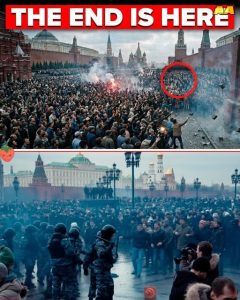
A warning inside Russia’s parliament has now turned into one of the most dramatic signals yet that Vladimir Putin’s power may be facing pressure from within.
For years, Putin has presented himself as the man who restored Russian strength, crushed disorder, and protected the country from collapse.
But now, one of Russia’s most recognizable political figures is openly warning that the country could be moving toward a historic breaking point.
Gennady Zyuganov, the veteran leader of Russia’s Communist Party, has sounded the alarm in front of the State Duma.
His message was explosive.
If Russia does not change course, the country could face echoes of 1917.
That reference is not casual.
In Russian history, 1917 means revolution, collapse, war exhaustion, public rage, and the fall of an old order that believed it could survive forever.
For Putin, that comparison is dangerous because it strikes directly at the image he has spent decades building.
He wants to be seen as the defender of stability.
Zyuganov’s warning suggests the opposite.
It suggests that the system Putin created may now be producing the same conditions that once destroyed Russia’s imperial rulers.
The Communist leader was careful with his words.
He claimed that his party supports Putin and his strategy.
But beneath that surface loyalty, the criticism was unmistakable.
When Zyuganov blamed “the government” for failing to listen, he was pointing toward the structure Putin controls.
When he warned of economic and social disaster, he was describing the consequences of Putin’s war-driven state.
That is what makes the speech so politically sharp.
It attacked the system without directly naming the man at the center of it.
The parallels with 1917 are impossible to ignore.
Back then, Russia was drained by war, overwhelmed by casualties, shaken by poverty, and ruled by leaders who seemed disconnected from ordinary people.
Today, Russia is again trapped in a long and costly war.
Its economy is under strain.
Its people are carrying the burden.
Its political elite remains protected while ordinary families pay the price.
That is why Zyuganov’s warning landed with such force.
He was not just speaking about history.
He was suggesting that history may be circling back.
The war in Ukraine has become central to this crisis.
What was once sold as a quick and decisive operation has turned into a grinding conflict with enormous human and financial costs.
Russia has spent vast sums to sustain the invasion.
Its military losses have been staggering.
Its economy has been reshaped around war production, sanctions pressure, labor shortages, and rising debt.
For ordinary Russians, the promise of stability is becoming harder to believe.
A state can hide bad news for a while.
It can censor media, punish critics, and flood television screens with patriotic slogans.
But it cannot fully hide inflation, job insecurity, funerals, and fear.
That is where the danger begins for Putin.
The source material points to slowing growth, hiring freezes, shrinking reserves, rising debt, and falling public confidence as signs of deeper instability.
Russia’s wartime economic growth has begun to weaken.
The temporary boost created by military spending cannot hide the structural damage forever.
Companies are reportedly freezing hiring as demand declines.
Some businesses are preparing for layoffs.
Government reserves are being depleted.
External debt has risen.
The country is still spending heavily on a war that has no clear end.
Putin has tried to blame officials for the economic slowdown.
But that blame game may not work forever.
The people around him cannot openly say what many already understand.
The crisis was created by the war.
And the war was Putin’s choice.
That is why Zyuganov’s words are so unsettling for the Kremlin.
They come from a political figure who understands how to speak inside Russia’s restricted system.
He knows how to criticize without crossing every red line.
He knows how to sound loyal while warning that the current direction could lead to national disaster.
That makes his message harder to dismiss.
It is not just an emotional outburst from the streets.
It is a warning delivered from inside the political establishment.
The warning also arrives as Putin’s public approval appears to be slipping.
In an authoritarian environment, even official or semi-official polling must be read carefully.
Many people may be afraid to answer honestly.
So when approval numbers decline, the real mood could be even worse than the published figures suggest.
Fear can silence people, but it cannot create genuine loyalty.
It can delay anger, but it cannot erase it.
Putin’s problem is that several pressures are now converging at once.
The war continues.
The economy weakens.
Businesses hesitate.
Families grieve.
Young men face military pressure.
Opposition voices, even controlled ones, are beginning to speak in darker tones.
That combination can become dangerous for any ruler.
The Kremlin may still appear strong from the outside.
Its security services remain powerful.
Its propaganda machine remains active.
Its political opposition remains limited.
But regimes rarely look fragile until the cracks suddenly become impossible to hide.
That is the lesson of 1917.
Systems built on fear and control can seem permanent right up to the moment they begin to fall apart.
Zyuganov’s reference to revolution is therefore more than political theater.
It is a signal that the Russian elite is nervous.
It shows that some figures inside the system understand the risks of ignoring public hardship.
They know that a society can absorb sacrifice only for so long.
They know that war fatigue can turn into anger.
They know that anger can turn into demands for change.
And they know that once people stop believing the leader can protect them, the old symbols of strength become hollow.
Putin may hope that oil revenue, repression, and patriotic messaging can buy him more time.
But time is not the same as a solution.
A temporary rise in oil income cannot rebuild trust.
It cannot bring back the dead.
It cannot repair a damaged economy by itself.
It cannot make ordinary Russians forget the cost of a war that keeps demanding more from them.
That is why the phrase “echoes of 1917” is so explosive.
It suggests that Russia’s current crisis is not just about Ukraine.
It is about the future of Putin’s entire political order.
The war has exposed weaknesses that were already inside the system.
Oligarchic wealth, corruption, demographic decline, economic dependency, and political fear have all become harder to hide.
The invasion did not create every Russian problem.
But it intensified many of them.
Now, Putin faces a question that every aging strongman eventually faces.
Can he keep blaming others for the consequences of his own decisions?
The answer may determine Russia’s future.
If economic pain deepens and public frustration spreads, the Kremlin may become more repressive.
If repression increases, resentment may grow even stronger.
If the war continues without victory, the sense of national exhaustion may become harder to control.
That is the cycle Zyuganov appears to be warning about.
A country can be pushed only so far before fear loses its power.
For now, Putin remains in control.
But control is not the same as confidence.
The fact that a veteran Russian political leader is publicly invoking 1917 shows how serious the mood has become.
The warning is dramatic, symbolic, and deeply uncomfortable for the Kremlin.
Russia may not be on the edge of revolution tomorrow.
But the idea that revolution can now be spoken aloud inside the State Duma is itself a sign that something has changed.
Putin built his rule on the promise that he would prevent chaos.
Now, the chaos he claimed to prevent may be rising from the very system he created.
