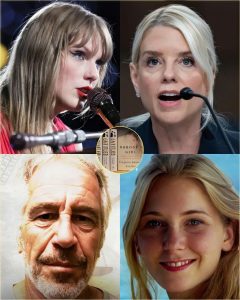
Hollywood is no stranger to spectacle. It thrives on drama, reinvention, and carefully curated narratives. But every so often, something breaks through the noise—something that doesn’t feel like promotion, doesn’t feel like entertainment, and certainly doesn’t feel controlled.
On April 2, Taylor Swift may have done exactly that.
Her latest release, “The Melody of Unveiling,” didn’t just debut—it detonated. Within 36 hours, the track reportedly amassed an astonishing 3.6 billion views, shattering expectations and overwhelming platforms. But as the numbers climbed, so did something far less quantifiable: unease.
Because for many listeners, this didn’t feel like a song.
It felt like a signal.

A Song… or a Statement?
From the very first notes, “The Melody of Unveiling” departs from Swift’s usual sonic palette. Gone are the polished hooks and familiar storytelling arcs. In their place: layered harmonies, eerie minimalism, and lyrics that seem deliberately fragmented—almost coded.
Listeners quickly began dissecting lines that reference silence, control, and truths buried beneath power. Social media erupted with interpretations. Some called it poetic abstraction. Others weren’t so sure.
One lyric in particular has gone viral:
“They taught the world to forget, but memory never dies in silence.”
For some, it’s art. For others, it’s something more pointed—something that feels uncomfortably specific.
“It doesn’t sound like metaphor,” one user wrote on X. “It sounds like testimony.”
The Livestream That Changed Everything
Hours before the song’s release, Swift appeared briefly on a livestream. No elaborate set. No branding. Just a direct-to-camera message.
She looked composed—but serious.
In that short appearance, she revealed that “The Melody of Unveiling” was inspired by Virginia Giuffre’s memoir, a deeply controversial and widely discussed account tied to powerful figures and long-standing allegations that have echoed through global headlines.
Swift described it as:
“A story the world tried to forget.”
That alone would have been enough to ignite discussion. But what came next sent shockwaves through both the entertainment industry and the internet at large.
She announced she was prepared to invest $689 million of her own money—not into promotion, not into touring, but into ensuring that:
“The truth cannot be buried again.”
There was no elaboration. No clear plan. No specifics.
Just a statement—and then the stream ended.

Silence Where There Should Be Noise
In the hours following the release, something unusual began to happen.
Not outrage. Not backlash.
Silence.
In an era where public figures respond to controversy within minutes, the absence of reaction was striking. Industry leaders, commentators, and influential voices—many of whom are typically quick to weigh in—remained quiet.
And that silence did not go unnoticed.
At the same time, users began reporting strange patterns online. Videos analyzing the song were allegedly disappearing. Comment sections on major platforms appeared restricted or locked. Some posts discussing the lyrics gained traction briefly—only to vanish hours later.
While there is no confirmed evidence of coordinated suppression, the perception alone was enough to fuel speculation.
“Why is everything about this being muted?” one content creator asked in a now-deleted video. “That’s the real story.”
The Internet Reacts: Theory, Fear, and Fascination
As expected, the internet did what it does best: it filled in the gaps.
Within hours, countless theories began circulating. Some suggested the song was a symbolic protest against systemic power structures. Others believed it was a direct reference to real-world events and individuals.
A more extreme corner of the discourse claimed the track contained hidden messages—coded references embedded in the lyrics, audio frequencies, even visual patterns in the music video.
While many of these interpretations remain speculative, the sheer intensity of the reaction is undeniable.
“This is bigger than music,” one viral post read. “This feels like someone trying to say something they’re not allowed to say directly.”

Art, Activism, or Something Else?
Taylor Swift has long been known for embedding layers of meaning in her work. Easter eggs, double meanings, and narrative complexity are part of her brand. But “The Melody of Unveiling” feels different—not just in content, but in tone.
There’s a weight to it.
A sense of urgency.
And perhaps most notably, a lack of clarity.
Unlike previous releases, there is no accompanying explanation, no behind-the-scenes breakdown, no interviews offering context. The ambiguity appears intentional—and that has only deepened the intrigue.
Is this a form of artistic expression pushing boundaries? A calculated move to spark conversation? Or something more deliberate—something meant to provoke not just thought, but action?
The $689 Million Question
Perhaps the most puzzling element of this unfolding story is Swift’s unprecedented financial commitment.
$689 million is not a symbolic gesture. It is a concrete, substantial investment—one that raises immediate questions.
What exactly is the money for?
Investigative journalism? Legal advocacy? Independent media platforms? Protection for whistleblowers?
As of now, there are no answers.
But the implication is clear: this is not just about a song.
It’s about something Swift believes requires resources, attention, and persistence on a massive scale.
And that alone has shifted the narrative from entertainment to something far more serious.
A Culture on Edge
The reaction to “The Melody of Unveiling” reflects something deeper than curiosity. It taps into a broader cultural moment—one defined by distrust, information overload, and the constant tension between visibility and control.
In a world where narratives are often shaped behind closed doors, the idea that a global superstar might be using her platform to challenge that dynamic is both compelling and unsettling.
Whether intentional or not, the song has become a lightning rod for these anxieties.
People aren’t just asking what the song means.
They’re asking what it implies.
Fact vs. Feeling
It’s important to draw a line between verified information and speculation.
At present, there is no confirmed evidence that content related to the song is being deliberately suppressed. Platform moderation, algorithmic behavior, and technical issues can all contribute to the disappearance or restriction of posts.
Similarly, interpretations of the lyrics remain subjective. What feels “too specific” to one listener may be metaphorical to another.
But perception matters.
And right now, the perception is that something unusual is happening.

“So I Will Sing Them”
Perhaps the most haunting element of this entire story is Swift’s final statement before ending her livestream:
“There are truths that cannot be spoken. So I will sing them.”
It’s a line that has been quoted, reposted, and analyzed countless times in the past 48 hours.
Is it poetic?
Yes.
But it’s also provocative.
Because it suggests a limitation—a boundary on what can be said openly. And it positions music not just as expression, but as a workaround.
A method of communication when other avenues are closed.
What Happens Next?
As the world continues to dissect “The Melody of Unveiling,” one thing is certain: this story is far from over.
Whether it ultimately proves to be a bold artistic statement, a misunderstood narrative, or something more consequential, the impact is already undeniable.
The song has captured global attention—not just for its sound, but for the questions it raises.
And those questions are not going away.
Did Taylor Swift simply release a powerful, thought-provoking piece of music?
Or did she open a door that someone, somewhere, would rather keep closed?
For now, there are no definitive answers.
Only silence.
And a melody that refuses to fade.
