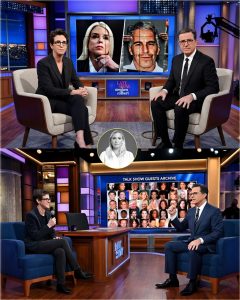
In an era where outrage cycles spin faster than ever and viral moments vanish almost as quickly as they appear, it takes something truly unusual to stop the internet in its tracks. But that’s exactly what happened following a late-night segment that many viewers are now calling one of the most unsettling—and potentially consequential—broadcasts in recent memory.
What began as a seemingly routine appearance quickly spiraled into something far more intense. Rachel Maddow and Stephen Colbert—two of the most recognizable voices in political commentary and late-night television—shared a stage and, according to viewers, stepped well beyond the familiar boundaries of satire, scripted critique, and controlled narrative.
This was not just comedy. This was not just commentary.
For many watching, it felt like something else entirely.
A Segment That Didn’t Feel Like a Segment
Late-night television has long walked a careful line. Hosts like Colbert have built careers blending humor with sharp political critique, while figures like Maddow are known for detailed, often methodical analysis. But what unfolded in this now-viral segment didn’t seem to fit neatly into either category.
From the very beginning, the tone felt different.
Gone were the usual punchlines and applause cues. Instead, viewers describe a shift—subtle at first, then unmistakable. The conversation reportedly moved quickly into territory that felt raw, unscripted, and, in some moments, deeply uncomfortable.
“They weren’t joking,” one viewer wrote on social media. “That’s what made it so intense. It felt like we weren’t supposed to be hearing this.”
And then came the moment that would ignite the internet.
Names, Allegations, and a Sudden Change in Atmosphere
As the segment progressed, names began to surface—names that many did not expect to hear in that context. Among them, Pam Bondi, a public figure whose inclusion alone triggered waves of confusion and speculation.
But it wasn’t just the names.
It was how they were presented.
Viewers describe a shift from commentary to something more suggestive—references to buried stories, unresolved cases, and what one moment in particular seemed to imply: that certain narratives had been deliberately suppressed.
One phrase, now circulating widely online, stood out above the rest:
“The woman buried by power.”
No clear explanation. No immediate context.
Just a phrase—and a pause that many say felt heavier than anything else said that night.
The Internet Reacts—Fast and Furious
Within minutes of airing, clips of the segment began circulating across platforms. By the next morning, it had exploded into one of the most talked-about media moments of the week.
Reactions have been sharply divided.
Some viewers are calling it a “truth bomb”—a rare moment where mainstream television broke free from its usual constraints and dared to hint at something deeper.
Others are far less enthusiastic.
Critics argue that the segment crossed a line—not just stylistically, but ethically. Without clear evidence or context, they say, referencing sensitive topics and individuals in such a manner risks fueling misinformation and unnecessary panic.
“It’s one thing to investigate,” one commentator posted. “It’s another to imply.”
And yet, the ambiguity may be exactly what’s driving the story forward.
Was It Planned—or Did Something Go Off Script?
One of the biggest questions now dominating discussions is whether the segment was carefully orchestrated or whether something unexpected unfolded live on air.
Television, especially at that level, is rarely accidental. Scripts are reviewed. Segments are rehearsed. Legal teams are often involved when discussions approach sensitive territory.
Which makes this moment all the more puzzling.
If it was planned, why allow such ambiguity?
If it wasn’t, how did it make it to air?
Some viewers believe the tension and pacing suggested something unscripted—a conversation that evolved in real time, possibly pushing beyond what had been intended.
Others argue the opposite: that the delivery, while intense, felt deliberate—crafted to provoke reaction without making explicit claims.
Either way, the result was the same:
A segment that people can’t stop talking about.
The Power of Suggestion—and the Danger of It
Part of what makes this moment so compelling—and controversial—is what wasn’t said.
There were no definitive accusations.
No clear narratives laid out from beginning to end.
Instead, there were fragments. References. Hints.
And in today’s media environment, that can be more powerful than any direct statement.
When viewers are left to connect the dots themselves, speculation fills the gaps. Online forums, social media threads, and comment sections quickly become echo chambers of interpretation, each version of the story evolving further from the original broadcast.
This is where concern begins to grow.
Because while ambiguity can spark curiosity, it can also create confusion—and in some cases, amplify misinformation.
A Cultural Moment—or Just Another Viral Flashpoint?
It’s tempting to label every viral media event as a turning point. But not all moments have staying power.
So the question remains:
Is this one of them?
There are signs that it might be.
The language used in the segment—particularly phrases like “buried by power”—has already begun appearing in broader discussions about transparency, media responsibility, and institutional trust.
Meanwhile, clips continue to circulate, reaching audiences far beyond the original broadcast.
Even those who haven’t seen the full segment are engaging with it—reacting to reactions, forming opinions based on fragments, and contributing to a narrative that is still evolving in real time.
The Bigger Question Everyone Is Asking
Beyond the specifics of what was said, a deeper question has begun to take hold:
If this is what can be said on air… what isn’t being said?
It’s a question that taps into something larger than any single segment.
A growing sense among some viewers that important stories may exist just beyond the edges of mainstream visibility—acknowledged, hinted at, but never fully explored.
Whether that perception is accurate or not is a separate issue.
What matters is that moments like this reinforce it.
Media Responsibility in the Age of Virality
For broadcasters, this situation presents a challenge.
On one hand, audiences are increasingly drawn to content that feels real, unscripted, and unfiltered.
On the other, the responsibility to provide clear, accurate information has never been more critical.
When a segment blurs those lines—even unintentionally—it raises important questions:
- How far should commentary go when discussing sensitive or unresolved topics?
- What role does ambiguity play in shaping public perception?
- And where is the line between raising awareness and fueling speculation?
These are not easy questions.
But they are necessary ones.
What Happens Next?
As of now, neither Maddow nor Colbert has issued a detailed clarification regarding the segment. That silence is only adding to the intrigue—and the speculation.
Will there be follow-up coverage?
A deeper explanation?
Or will this remain a one-off moment, left for the public to interpret on its own?
If history is any indication, the story isn’t over yet.
Because once a moment like this captures attention at this scale, it tends to evolve—through analysis, reaction, and, sometimes, revelation.
One Thing Is Certain
Whether you see it as a bold act of transparency, a misstep in judgment, or something in between, one fact is undeniable:
This wasn’t just another late-night moment.
It disrupted expectations.
It challenged norms.
And it left millions of viewers with more questions than answers.
In a media landscape defined by noise, that alone is enough to make it stand out.
But if the conversations now unfolding are any indication, this story may be doing more than standing out.
It may be opening a door.
And what lies behind it—real or perceived—is something people are now watching very closely.
