
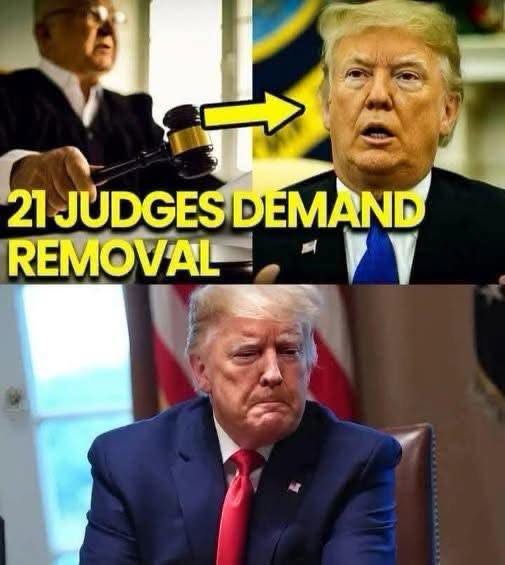
Twenty-one federal judges shattered the long-standing code of judicial silence, and in an instant, the fragile equilibrium of Washington D.C. dissolved into pure panic. Their private letter, aimed directly at a former president and delivered into the heart of Congress, moved through the capital like a contagion of truth. Allies scrambled to contain the narrative while political enemies circled like sharks in shallow water. No one knew who would strike first, or how far they would go. As social media erupted, the quiet foundations of democratic trust bega…
…n to buckle under the weight of an unprecedented intervention. For decades, the federal bench has operated behind a veil of stoic neutrality, viewing political engagement as a cardinal sin that threatens the legitimacy of the law. When these twenty-one jurists decided to step out from behind their gavels, they weren’t just sending a letter; they were signaling that the internal systems meant to preserve the republic were no longer functioning in the shadows.
What stunned the political establishment was not merely the content of the warning, but the sheer gravity of the source. Federal judges are trained to be the arbiters of conflict, not the participants. By choosing to risk accusations of partisan bias, these individuals signaled that they viewed the behavior of the former president not as a matter of policy, but as a fundamental threat to the rule of law itself. It was a move that carried no immediate force of law, yet it possessed something far more volatile: moral authority wrapped in the cold, hard reality of institutional fear.
Behind the closed doors of the Capitol, the reaction was immediate and polarized. Lawmakers scrambled to categorize the message, debating whether to treat the document as a vital constitutional alarm or a dangerous act of judicial overreach. To some, the judges were heroes acting as the final line of defense against executive overreach. To others, the letter was a breach of the very neutrality that keeps the judiciary from becoming just another political weapon. The air in the halls of power grew thick with suspicion, as every gesture began to look like a desperate power grab.
This incident exposed a raw, uncomfortable truth about the modern state of governance: when the trust between the branches of government frays, the mechanisms of democracy begin to cannibalize themselves. The judiciary, the executive, and the legislature are supposed to act as a check on one another, but when they stop speaking in the language of law and start speaking in the language of warning and counter-warning, the system loses its ability to self-correct.
We are left with a haunting question that lingers long after the headlines fade. How many such warnings can a democracy absorb before they lose their meaning? When the people who are supposed to be the final arbiters of justice feel compelled to abandon their silence, it is rarely a sign of strength. It is a sign that the fire is already at the door. The judges have spoken, but in a nation where every word is filtered through the lens of partisanship, the real danger is that we may have forgotten how to listen to the truth when it isn’t convenient.
