
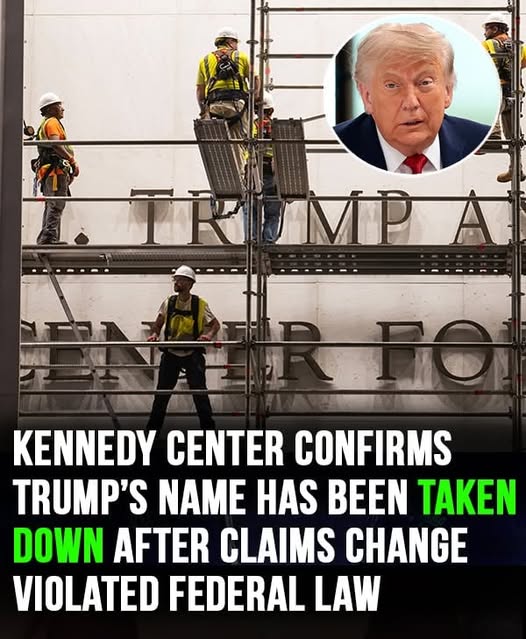
The crowd gasped as the heavy industrial tarps dropped and the first brass letters clattered to the pavement. For some, this was a long-overdue act of justice, a restoration of a sacred space. For others, it was nothing more than a calculated political hit job, a petty erasure of a legacy they believe deserves a permanent place in the national consciousness. Cheers, jeers, and camera shutters collided outside America’s most famous arts temple as the name was stripped from
…the very memorial built to honor a fallen president. What happened next left both sides seething, promising that this struggle over a few letters on a wall is merely the opening salvo in a much larger, more bitter fight for the soul of American public memory.
The removal of Donald Trump’s name from the Kennedy Center became far more than a cosmetic change or a simple maintenance project; it was a public verdict on the boundaries of ownership, legacy, and institutional restraint. For longtime patrons and critics alike, the court’s ruling affirmed a fundamental principle: that a monument forged in the collective grief for John F. Kennedy should not be repurposed as a trophy in a modern, hyper-partisan political war. They spoke of profound disgust, describing the original placement of the name as a branding iron applied to history that was never meant to be claimed by a successor.
Yet, the other side is not retreating into the shadows. Supporters and allies of the former president insist they are defending a leader they view as a transformative cultural force, vowing to pursue every legal avenue to reverse the decision. To them, the removal is not a correction of law, but an elitist snub of the millions of voters who see Trump as a central figure in the nation’s narrative. They are framing the incident as a litmus test for the establishment’s willingness to silence voices they find inconvenient.
Between a judge citing the cold, clear letter of federal law and a board now caught in the crosshairs of a polarized public, the building has transformed into a high-stakes battleground. The physical stone façade of the Kennedy Center stands unchanged, its architecture resilient against the elements, but the fractures in the country are now carved just as deeply into its marble as the names themselves. As the dust settles on the sidewalk, one truth remains: when we fight over who gets to be remembered on our monuments, we are really fighting over who gets to define what it means to be American.
