
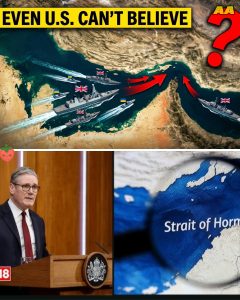
The Strait of Hormuz has become the most dangerous waterway in the world.
At its narrowest point, it is only 34 kilometers wide.
Yet through that narrow corridor flows a massive share of the world’s oil, liquefied natural gas, and fertilizer trade.
When that corridor breaks, the global economy feels it almost immediately.
Fuel prices rise.
Shipping routes freeze.
Airlines add surcharges.
Poorer countries face shortages.
And energy markets begin to panic.
According to the source material, traffic through the Strait has collapsed to a tiny fraction of its pre-war level after the escalation around Iran.
That disruption has turned the Strait into a global emergency.
But the most surprising answer to this emergency may not come from Washington alone.
It may come from Ukraine.
The same country still fighting Russia on its own soil is now preparing to help clear mines from the world’s most important energy choke point.
That possibility has stunned observers because it changes the way people think about Ukrainian power.
Ukraine is no longer only asking for help.
Ukraine is now offering help.
And that shift carries enormous strategic meaning.
The mission centers on four Ukrainian minehunter vessels currently positioned in the United Kingdom.
These ships are not symbolic props.
They are specialized mine countermeasure platforms built for dangerous waters where one mistake can destroy a vessel.
Two of them are former Royal Navy Sandown-class minehunters.
The other two are former Belgian and Dutch minehunters from the Tripartite class.
Together, they give Ukraine a rare and valuable capability.
They can locate, classify, and neutralize underwater mines in complex environments.
That matters because Iran’s mines are not simple floating explosives.
The source material describes mines with acoustic and magnetic sensors, designed to detect vessels without requiring direct contact.
Some are reportedly shaped to make sonar detection harder.
That makes the mission slow, technical, and dangerous.
Mine clearance is not a dramatic charge into battle.
It is patient work.
It requires sonar accuracy, trained crews, calm nerves, and constant discipline.
One wrong move can close a route again.
One missed mine can turn a reopened waterway into a disaster.
That is why Ukraine’s role matters so much.
Its crews have trained with NATO partners.
Its ships have been prepared for interoperability.
And the United Kingdom has helped build the structure around the deployment.
If a durable ceasefire allows the mission to begin, Ukraine would be entering one of the most strategically sensitive maritime operations of the year.
The stakes go far beyond the Gulf.
Every day the Strait remains blocked, global oil prices remain under pressure.
Every day prices stay high, Russia benefits.
That is the hidden link connecting Hormuz to Ukraine’s front lines.
The source material argues that Russia gained a major financial windfall when the disruption drove oil prices upward.
Even with sanctions and export pressure, higher oil prices can help Moscow earn more from the barrels it still manages to sell.
That money matters.
It pays for weapons.
It supports military production.
It helps fund salaries.
It keeps the war economy moving.
In other words, mines in the Strait of Hormuz can indirectly help Russian artillery fire in Ukraine.
That is why Kyiv has a direct interest in reopening the waterway.
Clearing the mines would increase confidence in shipping.
Shipping confidence would ease the energy shock.
Lower oil prices would reduce Russia’s windfall.
And reducing Russia’s windfall would weaken Putin’s ability to sustain the war.
This is not charity.
It is strategy.
Ukraine understands that the war is fought not only with tanks, drones, and trenches.
It is also fought through energy prices, export routes, insurance markets, and global supply chains.
Kyiv has already used drone strikes against Russian refineries and ports to pressure Moscow’s energy system.
A Hormuz mine-clearing mission would extend that same logic onto a global stage.
Instead of only hitting Russian oil infrastructure directly, Ukraine would help reduce the market conditions that make Russian oil more valuable.
That is a sophisticated move.
It shows that Ukraine is thinking beyond survival.
It is thinking like a state shaping the battlefield across multiple regions.
For Putin, that is a nightmare.
He invaded Ukraine expecting to weaken it.
Instead, Ukraine has become more militarily innovative, more diplomatically connected, and more useful to global security partners.
Russia damaged Ukraine’s traditional navy early in the war.
But Ukraine responded by becoming a pioneer in naval drones, long-range strikes, and unconventional maritime warfare.
Now, with British-built minehunters and NATO-trained crews, Ukraine may be preparing to project naval capability far beyond the Black Sea.
That sends a powerful message.
Ukraine does not need to challenge Russia only near Crimea.
It can hurt Russia’s war financing by helping stabilize Hormuz.
It can build partnerships in the Gulf.
It can work with the UK, France, Italy, the Baltic states, and other coalition members.
It can move from being a recipient of security aid to becoming a provider of security solutions.
That transformation may be one of the most important developments of the war.
For years, Ukraine was described mainly as a country in need.
It needed weapons.
It needed funding.
It needed air defense.
It needed political backing.
All of that remains true.
But this mission shows another truth.
Ukraine also has capabilities others need.
It has battle-tested crews.
It has modern maritime lessons learned under fire.
It has experience fighting a larger enemy with asymmetric tools.
And it has a strong incentive to help solve crises that feed Russia’s treasury.
The timing remains uncertain.
The mission depends on the security situation in and around Hormuz.
The United Kingdom and France are unlikely to send vessels into the Strait if the war appears likely to restart.
A fragile ceasefire is not enough.
Minehunters need a realistic chance to operate without becoming targets.
But once a durable ceasefire is in place, the planning appears far more advanced than many people realize.
The coalition framework has reportedly been discussed.
The ships are ready.
The crews are trained.
The intelligence picture has been developing through drones, satellites, and patrol aircraft.
That means the mission could move quickly once political conditions allow.
The global consequences would be immediate.
Oil prices could ease.
Gasoline prices could fall.
Shipping confidence could return.
Energy-dependent economies could breathe again.
And Russia’s extra revenue from the crisis could begin evaporating.
That is why this story matters.
It is not only about mines.
It is about who controls the pressure points of the global economy.
It is about whether Ukraine can turn a Middle Eastern crisis into a strategic blow against Moscow.
It is about whether the old assumptions of naval power still hold in a world where smaller countries with specialized capabilities can shape global outcomes.
The Strait of Hormuz may be thousands of miles from Kyiv.
But in the economics of modern war, distance means less than it once did.
A mine cleared in the Gulf can affect oil prices in Europe.
A lower oil price can shrink Russia’s budget.
A weaker Russian budget can affect the battlefield in Ukraine.
That is the chain Kyiv appears to understand.
And that is why Putin has reason to worry.
Ukraine’s minehunters may not fire a missile.
They may not sink a ship.
They may not appear dramatic on television.
But if they help reopen Hormuz, they could do something far more damaging to Moscow.
They could cut into the cash flow that keeps Russia’s war alive.
In 2026, power is not only measured by aircraft carriers and missile strikes.
It is measured by who can solve the crisis everyone else fears.
Ukraine may be preparing to do exactly that.
And if those four minehunters finally sail from Britain toward the Gulf, they will carry more than sonar equipment.
They will carry proof that Ukraine has become a global security actor in its own right.
