
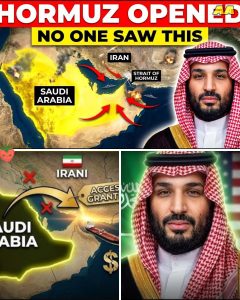
Saudi Arabia’s bold Hormuz bypass strategy is reshaping the Middle East, weakening Iran’s most feared energy threat and forcing Washington to confront a new reality in the Gulf.
For decades, the Strait of Hormuz has been one of the most dangerous choke points in the global economy.
A narrow stretch of water between Iran and Oman, it carries a massive share of the world’s oil trade and has long been treated as the pressure valve of the Middle East.
Whenever tension rises, the same fear returns.
What happens if Iran closes the Strait.
That single question has shaped military planning, oil prices, diplomatic strategy, and global market anxiety for more than 40 years.
Now Saudi Arabia has made a move that could change that calculation forever.
According to the source material, Riyadh has accelerated a major infrastructure strategy designed to reduce its dependence on the Strait of Hormuz and move oil through alternative routes toward the Red Sea.
The centerpiece of that strategy is the East-West pipeline, also known as the Petroline.
This route connects Saudi oil fields in the east to the Red Sea port of Yanbu.
In practical terms, it gives Saudi Arabia a way to export oil without relying entirely on the Persian Gulf.
That may sound technical.
It is not.
It is a geopolitical earthquake.
Iran’s power in the Strait has always depended on fear.
Tehran did not need to close Hormuz every day.
It only needed the world to believe it could.
That belief created a risk premium in global oil markets.
It gave Iran leverage during crises.
It forced the United States and its allies to keep enormous military resources in the region.
And it made Gulf producers vulnerable to every Iranian threat, naval maneuver, or proxy escalation.
Saudi Arabia’s bypass strategy attacks that leverage without firing a shot.
It does not destroy Iran’s navy.
It does not require a direct confrontation.
It simply reduces the value of Iran’s threat.
If Saudi oil can keep moving even when Hormuz is unstable, Tehran’s ability to panic the market weakens.
That is why this move matters so deeply.
It turns infrastructure into strategy.
It turns pipelines into deterrence.
It turns logistics into power.
For Crown Prince Mohammed bin Salman, this is also about survival and autonomy.
Saudi Arabia still depends heavily on oil revenue to fund its economy and its Vision 2030 transformation.
Every disruption in the Gulf threatens that agenda.
Every oil shock creates uncertainty for investors.
Every Iranian threat risks undermining the kingdom’s long-term modernization plan.
By building around Hormuz, Riyadh protects not only its oil exports, but its future.
The move also sends a message to Washington.
Saudi Arabia no longer wants to be treated as a client state dependent entirely on American protection.
For decades, the U.S.-Saudi bargain was simple.
Saudi Arabia helped stabilize energy markets.
The United States provided security.
But American policy has become less predictable across administrations.
Riyadh has watched Washington shift between engagement, criticism, withdrawal, and renewed partnership.
MBS appears determined to make Saudi Arabia less vulnerable to those swings.
That does not mean Saudi Arabia is abandoning the United States.
It means Saudi Arabia is building options.
It is deepening ties with China.
It is managing relations with Russia through OPEC-plus.
It is exploring normalization with Israel under specific conditions.
It is maintaining security cooperation with Washington.
And it is quietly building infrastructure that gives it more freedom of action.
That is the real story behind the Hormuz bypass.
Saudi Arabia is not choosing one camp.
It is making itself too important for every camp to ignore.
For Iran, the implications are severe.
Hormuz has been Tehran’s most famous strategic card.
If that card loses power, Iran’s regional posture weakens.
The Islamic Republic can still threaten shipping.
It can still use proxies.
It can still create instability.
But if major Gulf producers can route around its pressure points, Tehran’s threats become less decisive.
That is a major psychological blow.
It also complicates Iran’s relationship with Saudi Arabia.
The two countries restored diplomatic ties in 2023 through a China-brokered agreement.
But normalization did not erase rivalry.
It simply moved the competition into a quieter, more sophisticated phase.
Saudi Arabia is engaging Iran diplomatically while also reducing Iran’s leverage structurally.
That is a far more dangerous challenge for Tehran than another angry speech.
It is a strategy Iran cannot easily answer.
The Red Sea dimension adds another layer of complexity.
By increasing the importance of Yanbu and Red Sea export routes, Saudi Arabia also increases its exposure to threats from the Houthis in Yemen.
The Houthis, backed by Iran, have already shown they can disrupt Red Sea shipping with drones and missiles.
That means the chessboard is shifting, not disappearing.
Hormuz may matter less for Saudi Arabia, but Red Sea security now matters more.
This could push Riyadh to strengthen naval capabilities, deepen maritime partnerships, and pressure Iran to restrain its proxies.
The bypass also changes global energy markets.
For decades, oil traders priced in the risk that Hormuz could close.
Saudi Arabia’s alternative route does not eliminate that risk because Qatar, Kuwait, Iraq, and others remain exposed.
But it reduces the vulnerability of the world’s most important oil exporter.
That alone can reshape market expectations.
If the market believes Saudi barrels are safer, the panic effect of Iranian threats becomes smaller.
That could reduce volatility over time.
It could also strengthen Saudi Arabia’s position inside OPEC and beyond.
China is watching closely.
Beijing is the world’s largest oil importer and relies heavily on Gulf energy.
Any route that reduces the risk of Hormuz disruption serves Chinese energy security.
That helps explain why China has invested so heavily in relations with Saudi Arabia and why Beijing’s role in Saudi-Iran diplomacy matters.
China wants stable energy flows.
Saudi Arabia wants strategic autonomy.
Those interests now overlap more than ever.
Washington faces the hardest adjustment.
The United States remains the strongest military power in the Gulf.
But military dominance no longer guarantees political control.
Saudi Arabia is proving that infrastructure, capital, and diplomacy can reshape the region without waiting for American permission.
That forces U.S. policymakers to rethink the relationship.
If Washington treats Riyadh as a subordinate partner, it risks pushing the kingdom closer to China.
If it treats Saudi Arabia as an independent strategic power, it may preserve influence in a changing region.
That choice will define the next decade of U.S. policy in the Gulf.
The larger message is clear.
The Middle East is no longer frozen in the old order.
Iran’s threats are being bypassed.
Saudi Arabia is becoming more independent.
China is becoming more involved.
The United States is being forced to adapt.
And regional power is increasingly measured not only by weapons, but by infrastructure.
The Strait of Hormuz is still critical.
It is still dangerous.
It can still shake global markets.
But it no longer holds the same uncontested power over Saudi Arabia that it once did.
Riyadh has not conquered the Strait.
It has not closed it.
It has done something more subtle and perhaps more effective.
It has built a way around it.
And in doing so, Saudi Arabia may have changed the future of Gulf power without firing a single shot.
